
Signs Your Chimney Needs Cleaning
Campfire smell in July, smoke rolling back, black flakes in the firebox — the seven signs your flue is asking for a sweep before burn season.
Read the Article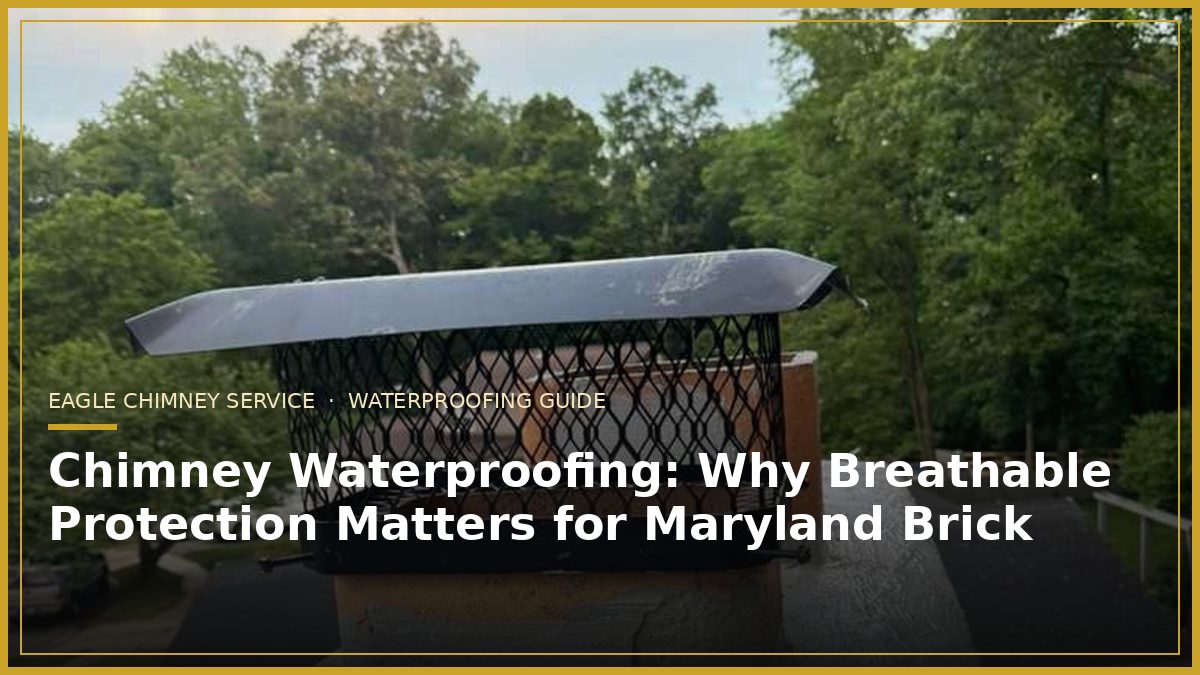
The fast answer: chimney waterproofing is a breathable treatment applied to the outside of a sound masonry chimney. It stops liquid rain from soaking into brick and mortar, while still letting water vapour inside the wall escape outward. That second half is the whole point: a film-forming sealer or ordinary paint traps moisture inside the masonry, and trapped moisture is what freezes, expands and pops the faces off Maryland brick. Waterproofing belongs on a chimney whose crown, cap, flashing and mortar are already in decent repair — it protects sound masonry, it does not rescue failing masonry. The featured photo shows a real capped chimney top with a coated crown from one of our Maryland jobs.
Brick and mortar look solid, but both are porous. Every wind-driven rain wets the stack, and the masonry drinks a share of it in. In a mild climate that would mostly be a slow cosmetic problem. In Maryland, DC and Northern Virginia it becomes a mechanical one, because the wet season runs straight into freeze-thaw: water inside brick and mortar expands as it freezes, then thaws, then freezes again, a little deeper each winter. The results are the familiar ones our crews photograph every spring — mortar joints recessed and crumbling, white salt staining on the brick face, and spalling, where the face of a brick shears off in layers. Our guide to chimney masonry repair and tuckpointing shows what that damage looks like up close.
There are two families of products that get sold as chimney waterproofing, and they behave in opposite ways. A breathable, vapour-permeable treatment soaks into the pores of the brick and lines them, so liquid water beads and runs off instead of absorbing — while vapour from inside the wall can still pass through and dry out. A film-forming product does the reverse: it lays a skin over the surface. That skin may look sealed for a season, but moisture already in the wall, and moisture arriving from the flue side, now has nowhere to go. Trapped behind the film, it freezes closer to the surface and pushes the film — and sometimes the brick face with it — off the wall. Paint on an exterior chimney causes the same problem for the same reason. If a product promises a shiny, sealed finish, it is the wrong chemistry for masonry, whatever the label calls it.
Applied to the right chimney, breathable chimney waterproofing slows the whole water cycle down: less rain absorbed, fewer freeze-thaw cycles doing damage inside the wall, and mortar joints that keep their strength for more of their natural life. It is maintenance in the truest sense — it protects time you have already bought with sound masonry.
What it does not do is just as important. It does not stop a leak. Water entering through a cracked crown, failed flashing, open mortar joints or a missing cap will keep entering, and coating the brick around those failures can hide the symptoms while the cause continues. It does not repair recessed joints — that is tuckpointing. It does not fix a crown that is crumbling — that is the repair sequence in our guide to chimney crown damage. And it is never a substitute for finding out where water is actually coming from, which is why our chimney leak detection work starts with the top of the stack, in photos, before any product is discussed.
On a typical visit, the sequence looks like this:
The best candidate is a chimney that is fundamentally sound but visibly thirsty: brick that darkens heavily and stays dark long after rain, early white efflorescence showing that water is travelling through the wall, mortar that is beginning to recess but is not yet crumbling, or masonry that was repointed in recent seasons and deserves protection for that investment. A chimney on a weather-exposed elevation — no tree cover, full wind-driven rain — benefits most, because it takes the most water. Late fall is a sensible moment to assess it: the stack has just shown you a full season of behaviour, and protecting sound masonry before the hardest freeze-thaw weeks is worth more than the same work after another winter inside the wall.
You cannot judge mortar depth from the driveway, but you can watch how your chimney handles water. After a steady rain, note whether the brick darkens unevenly and how long it stays wet compared with the brick on the house wall. Look for white staining, for green or dark growth low on the stack, and for mortar dust in the beds below the chimney after dry weather. Inside, damp or musty smells near the fireplace after storms, and any ceiling stain near the chimney chase, mean water is completing the trip — that is an inspection first, not a coating. Bring those observations to the visit; when a stain appears and how the stack dries are genuinely useful diagnostic details.
Waterproofing is one layer of a dry-chimney system, not the whole system. A fitted cap keeps rain out of the flue itself — our guide to whether a chimney cap is worth it covers that choice — and a sound, sloped crown sheds the water that lands on top of the stack, while sound flashing seals the roofline, as our article on chimney flashing leaks explains. Fold the masonry into the same annual rhythm as the flue: inspect every year, sweep when deposits reach 1/8 inch, and have the brickwork read at that visit while any new recessing or staining is still a small observation instead of a repair.
That order is the whole decision, and it is one we make from the roof, with photos, not from a sales script. If your masonry is sound, we will say so and explain what breathable protection would buy it. If joints, crown or flashing need work first, you will see exactly why, in the same images we are looking at. Eagle Chimney Service is Licensed & Insured · MHIC #117311, and every job is photo-documented and emailed the same day. Call (855) 424-6217 or send the lead form on our appointment page, and let us get your chimney shedding water properly before winter settles into the brick.
Talk to a specialist — photo-documented inspections and upfront written estimates across 375 communities in Maryland, DC and Northern Virginia.
Campfire smell in July, smoke rolling back, black flakes in the firebox — the seven signs your flue is asking for a sweep before burn season.
Read the Article
What actually drives the price of a chimney sweep in Maryland — flue count, creosote stage, access — and how to read any quote you are given.
Read the Article
A cap costs a fraction of the repairs it prevents. The Maryland math on rain, raccoons and rusted dampers — and when a cap is not the answer.
Read the Article