
Signs Your Chimney Needs Cleaning
Campfire smell in July, smoke rolling back, black flakes in the firebox — the seven signs your flue is asking for a sweep before burn season.
Read the Article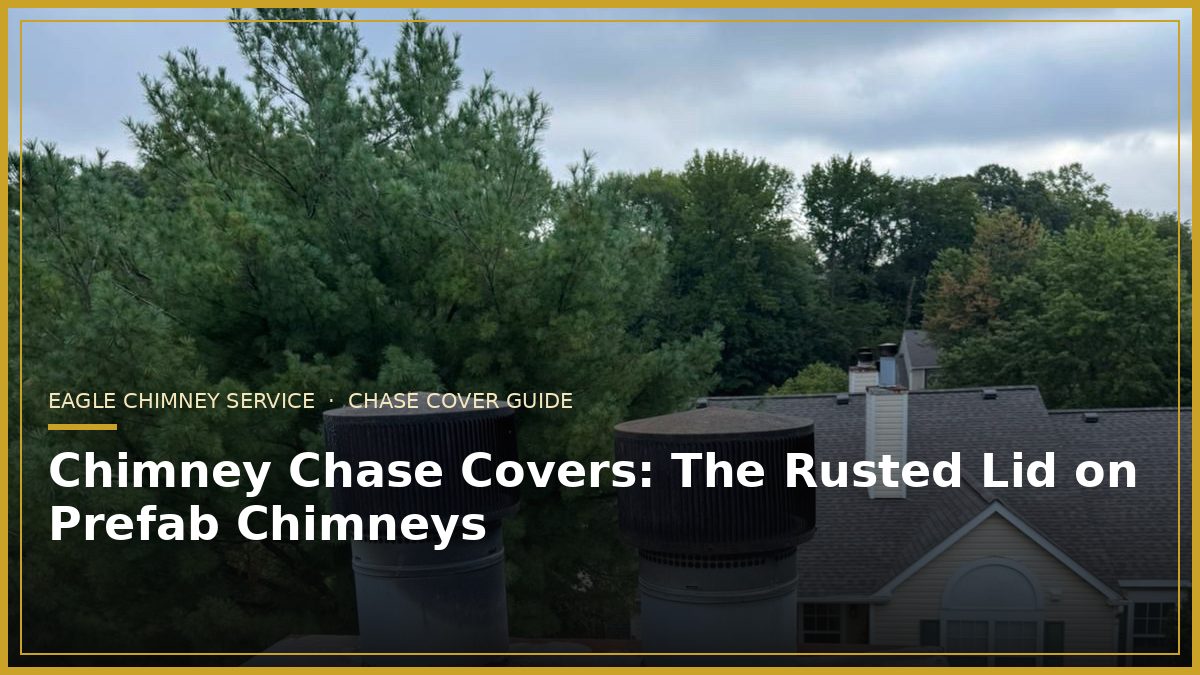
The fast answer: if your home has a factory-built (prefab) fireplace, your chimney is a framed wooden or metal chase, and the flat metal lid sealing its top is called a chase cover. Most builder-installed covers are thin galvanized steel that eventually rusts — often pooling water first, then staining, then rusting through in pinholes and seams. Once it perforates, every rain falls directly inside the chase onto the flue, the framing and the top of the fireplace. A rusted-through cover is replaced, not patched: a new cover is custom-measured and fabricated, most durably in stainless steel, with a slight slope and a drip edge so water runs off instead of sitting. The featured photo shows a real rusted chase cover over twin flues from one of our Maryland jobs — that orange staining across the lid is the classic late-stage picture.
Homeowners use these words interchangeably, but they belong to two different kinds of chimney. A masonry chimney is brick all the way up, and its top slab is a concrete crown — our guide to chimney crown damage covers that system. A prefab chimney is different construction entirely: the metal flue pipes run up inside a framed chase — a box of lumber and siding, or sometimes stucco or brick veneer over framing — and the chase needs a metal roof of its own. That roof is the chase cover: a one-piece pan, cut for the chase and pierced where the flues exit. The cap then sits on each flue pipe above the cover, keeping rain and animals out of the pipe itself. When someone says their prefab chimney leaks from the very top, the chase cover is the first suspect, because it is the largest horizontal surface on the system and it takes every storm flat-on.
The cover most builders install is galvanized steel, chosen because it is inexpensive. Three things work against it in Maryland, DC and Northern Virginia weather. First, many are fabricated almost flat, so rainwater pools on top instead of shedding; standing water is rust's best friend. Second, the galvanized coating is thinnest exactly where it is worked hardest — at the bent edges, the seams and the collars around the flue holes — so those are the spots that give up first. Third, the cover lives in a harsh spot: summer heat baking it, winter freeze-thaw cycling it, and acidic moisture condensing around the flue exits. The result follows a predictable order: dull patches, rust streaks, a sagging pan that pools even more water, and finally pinholes and split seams. By the time rust is obvious from the ground, the cover is usually well along that sequence.
None of these prove the cover alone is at fault — siding joints, flashing and caps fail too — which is why the honest first step is a look at the top itself, with photos, before any replacement is quoted.
A chase is a hollow box, and that is what makes a perforated cover serious. Rain that enters does not land on masonry that can dry out; it lands on wood framing, insulation and the outer wall of the flue pipe. Framing that stays wet rots. Wet insulation loses its value and holds moisture against everything around it. The flue pipe itself rusts from the outside in, which can quietly shorten the life of the whole prefab system. And because the water travels, the stain that finally appears indoors may show up a room away from where the rain came in. This is the same lesson masonry teaches with crowns, one system over: top-of-chimney water problems are cheapest in the season they are caught, because the repair is still the lid — not the lid plus everything it soaked.
Surface rust caught early, on a cover that is still solid and still shedding water, can sometimes be cleaned and treated to buy time — that is a maintenance call a sweep makes from the roof, looking at the actual metal. But a cover that has pinholes, split seams or a sagging pan has finished its structural life, and coating over perforation does not restore it: the water paths remain, hidden under fresh paint, still feeding the chase. Replacement is the real fix, and it is a measured job, not an off-the-shelf one. The old cover comes off, the top of the chase and the flue exits are inspected and photographed while they are open, and the new cover is fabricated to the chase's exact dimensions — sized for your flues, sloped to shed water, with raised collars around each flue opening and a drip edge that throws runoff clear of the siding. Our chimney chase cover work follows exactly that sequence.
A replacement cover can be fabricated in galvanized steel again, and it will repeat the same story on the same schedule. Stainless steel is the material our crews recommend for the replacement, for the same reason it wins on caps: it does not rely on a coating that can wear through, so the rust clock does not simply restart. It is also stiff enough to hold its slope instead of oil-canning into a new puddle. Whichever metal is chosen, the details matter as much as the material — proper slope, sealed seams, collars fitted to the flues, and a storm collar above each penetration. A flat, poorly fitted cover in good metal still pools water; a well-made one sheds it for decades.
You cannot judge a cover's metal from the driveway, but you can watch for its messages. After rain, look for fresh rust streaks on the chase siding and for drip lines staining one face more than the others. From an upstairs window, look at whether water stands on the cover long after the roof has dried. Inside, note any new ceiling stain near the chimney chase, any musty smell after storms, and any rust showing at the top of the firebox. Bring those observations to the visit — when a stain appears and how the top dries are genuinely useful diagnostic details, the same way they are for the flashing problems in our article on chimney flashing leaks.
Prefab systems sometimes get treated as maintenance-free because there is no masonry to repoint. They are not: the flue still builds creosote, the cap still weathers, and the chase cover is quietly ageing in full weather the whole time. The fix is the rhythm you already know — inspect every year, sweep when deposits reach 1/8 inch — with the top of the chase read at that same visit, in photos, while a tired cover is still a one-part replacement instead of a framing repair. Late November is a sensible moment for that check in Maryland: the cover has just shown you a full season of rain, and it is about to meet freeze-thaw with whatever water it is holding.
Tell us what you are seeing — the streaks, the stain, the dripping sound after rain — and we will look at the top of your chase with a camera before recommending anything. If the cover is sound, the photos will say so. If it is perforated, you will see the rust we are basing the replacement on, with a written estimate before any work is scheduled. Eagle Chimney Service is Licensed & Insured · MHIC #117311, and every job is photo-documented and emailed the same day. Call (855) 424-6217 or send the lead form on our appointment page, and let us get a solid lid back on your chimney before winter rain finds the holes.
Talk to a specialist — photo-documented inspections and upfront written estimates across 375 communities in Maryland, DC and Northern Virginia.
Campfire smell in July, smoke rolling back, black flakes in the firebox — the seven signs your flue is asking for a sweep before burn season.
Read the Article
What actually drives the price of a chimney sweep in Maryland — flue count, creosote stage, access — and how to read any quote you are given.
Read the Article
A cap costs a fraction of the repairs it prevents. The Maryland math on rain, raccoons and rusted dampers — and when a cap is not the answer.
Read the Article